
Choosing a whitening treatment is mostly an exercise in matching a format to a situation. The active part of the process is broadly similar whichever route you take, but the way a treatment is arranged around you differs, and those differences are what make one option sensible for one person and awkward for another. Someone whitening for the first time has different needs from someone topping up a shade they already had. Someone arranging treatment alongside a partner has different logistics again.
This page sets out what each published treatment involves, drawn from what the business itself publishes rather than from assumption. It describes what is included, the kind of circumstances each format tends to suit, and the practical considerations worth weighing before you decide. Where a detail would matter to you and is not published anywhere, this page says so rather than filling the gap with a plausible guess.
One thing you will not find here is cost. Current figures are published and revised by the business directly, and reproducing them on a separate page is a reliable way to end up showing someone an out-of-date number they then plan around. What this page does instead is explain what you would actually be receiving in each case, which is the part that tends to be described least clearly and matters most once treatment begins.
If you want to compare the current cost before deciding which format suits you, you can review the Laser Teeth Whitening Prices published for Leicester.
It is also worth saying at the outset that no whitening treatment is appropriate for everyone. Suitability depends on the condition of your teeth and gums, any existing dental work, and your dental history, and it is assessed individually rather than assumed from a description on a website. Nothing below should be read as confirmation that a particular treatment is right for you.
Full treatment carried out in your home
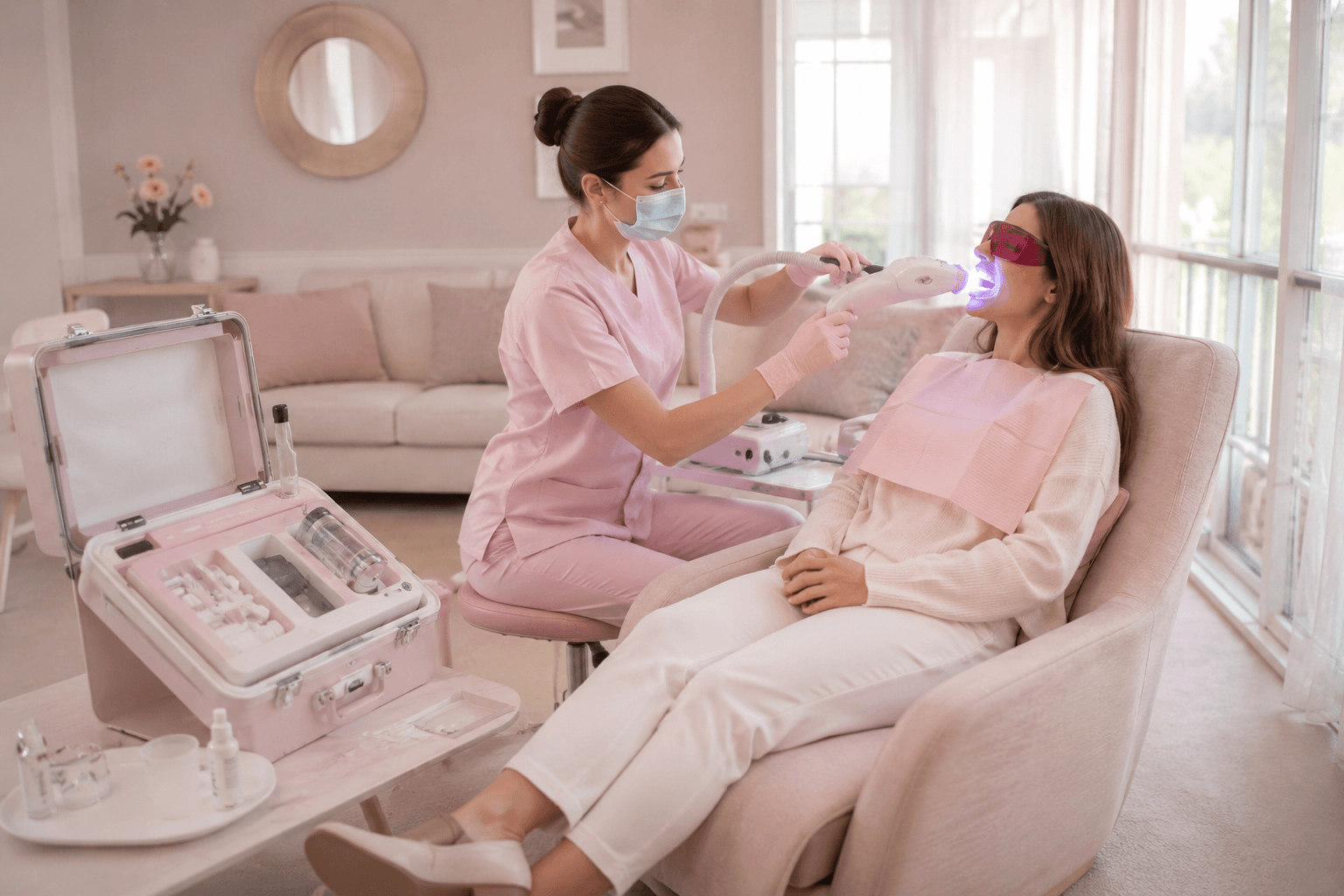
This is the standard first-time route, and the format that most of the published service is built around. The specialist travels to you, and the whole sequence takes place wherever you normally are rather than in a clinic you have to find, park near and arrive at on time.
As published, it comprises a pre-consultation in your home, a laser teeth whitening treatment, and aftercare. The consultation and the treatment are counted separately, which is worth noticing: the assessment is treated as a distinct stage rather than a few minutes of preamble folded into the appointment.
The format tends to suit people who have not had professional whitening before, precisely because it front-loads the assessment. If you are unsure whether your teeth will respond well, whether existing dental work complicates matters, or what a realistic outcome looks like in your particular case, having that examined properly before any gel is applied is the part that protects you from disappointment.
It also suits anyone for whom the logistics of a clinic visit are the actual obstacle. People with young children, irregular shift patterns, limited transport, mobility difficulties, or anxiety about clinical settings often find that a treatment which comes to them removes the barrier that had been quietly postponing it for years. The published emphasis on a relaxed setting reflects that.
There are practical considerations that go with having a treatment at home. You will need somewhere the specialist can work comfortably with adequate light and a power supply, and enough uninterrupted time to sit still through the active stage without being pulled away. Household interruptions that would be impossible in a clinic are entirely possible at home, so it is worth thinking about when in the day you would genuinely be undisturbed rather than nominally free.
Used sensibly, this is a treatment you plan around rather than squeeze in. Because staining redevelops through ordinary eating and drinking, whitening is best treated as an occasional intervention rather than something to repeat whenever the shade drifts slightly. The frequency that is appropriate for you is a question for the specialist attending, and it depends on how your teeth responded the first time.
If you are considering this option, the details worth raising at the consultation are any sensitivity you have experienced, any crowns, veneers, bridges or white fillings on the teeth you want treated, and any recent dental work. Each of those can change what is achievable, and each is better established before treatment than discovered afterwards.
Full treatment arranged for two people
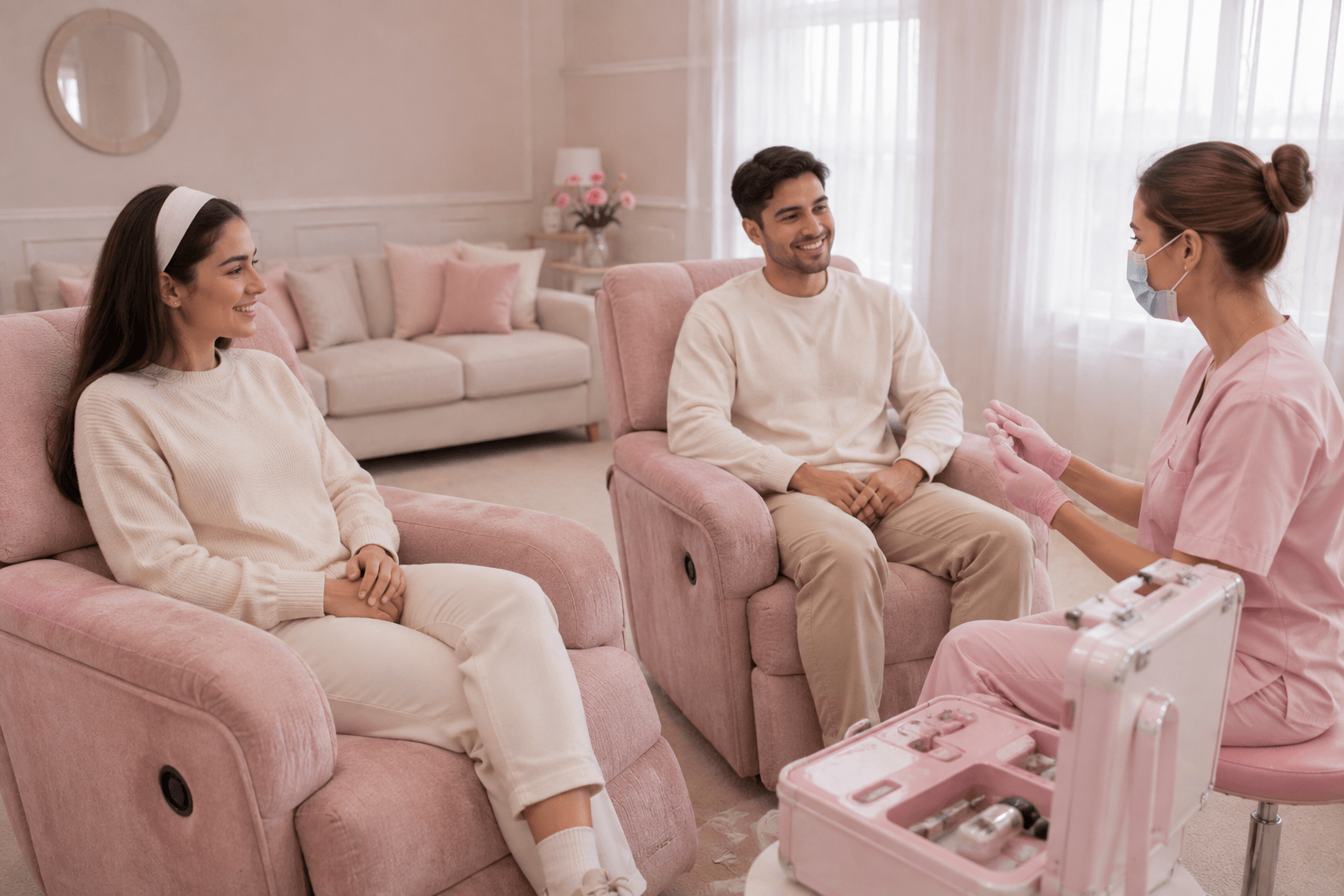
This option covers two people treated in connection with the same arrangement, which is the format couples, friends, siblings and people preparing for the same occasion tend to ask about. Weddings account for a good share of it, but so do family events and any situation where two people want the same thing done at roughly the same time.
As published, it comprises two pre-consultations in your home, two laser teeth whitening treatments, and aftercare described as full aftercare. The consultations are counted individually, which matters more than it might appear. Two people who live in the same house and drink the same coffee can still have quite different starting shades, different dental work and different sensitivity histories, and assessing them separately is the only way those differences get accounted for.
It is worth being precise about how the published inclusions are structured, because they are not simply doubled. The consultations and treatments are listed as two of each, while the aftercare appears once and is described in different terms from the aftercare attached to the single-person route. Whether that means one shared set of guidance, one set of materials intended to cover both people, or something more extensive, is not published. This page is not going to guess at it. If you are considering this option for two people who will both want aftercare of their own, it is a fair and specific thing to ask before anything is arranged.
The format suits people whose reason for whitening is shared. If you are both working towards the same date, having the treatments arranged together removes the coordination problem of two separate bookings that need to land in a sensible window. It also tends to suit people who would rather not do it alone, which is a more common motivation than it is usually given credit for.
What it does not do is make two people interchangeable. Suitability is still assessed individually, and it is entirely possible for one person to be straightforward and the other to have a complication that needs addressing first. It is worth going in with the expectation that the two assessments may not produce the same answer, and that this is the process working correctly rather than failing.
Practically, treating two people in one visit means a longer period during which your home is given over to it. If you are the host, the space and time considerations that apply to a single treatment apply for longer. Agreeing in advance who goes first, and what the other person will do meanwhile, is a small piece of planning that makes the visit run considerably more smoothly.
Refresh treatment for returning customers
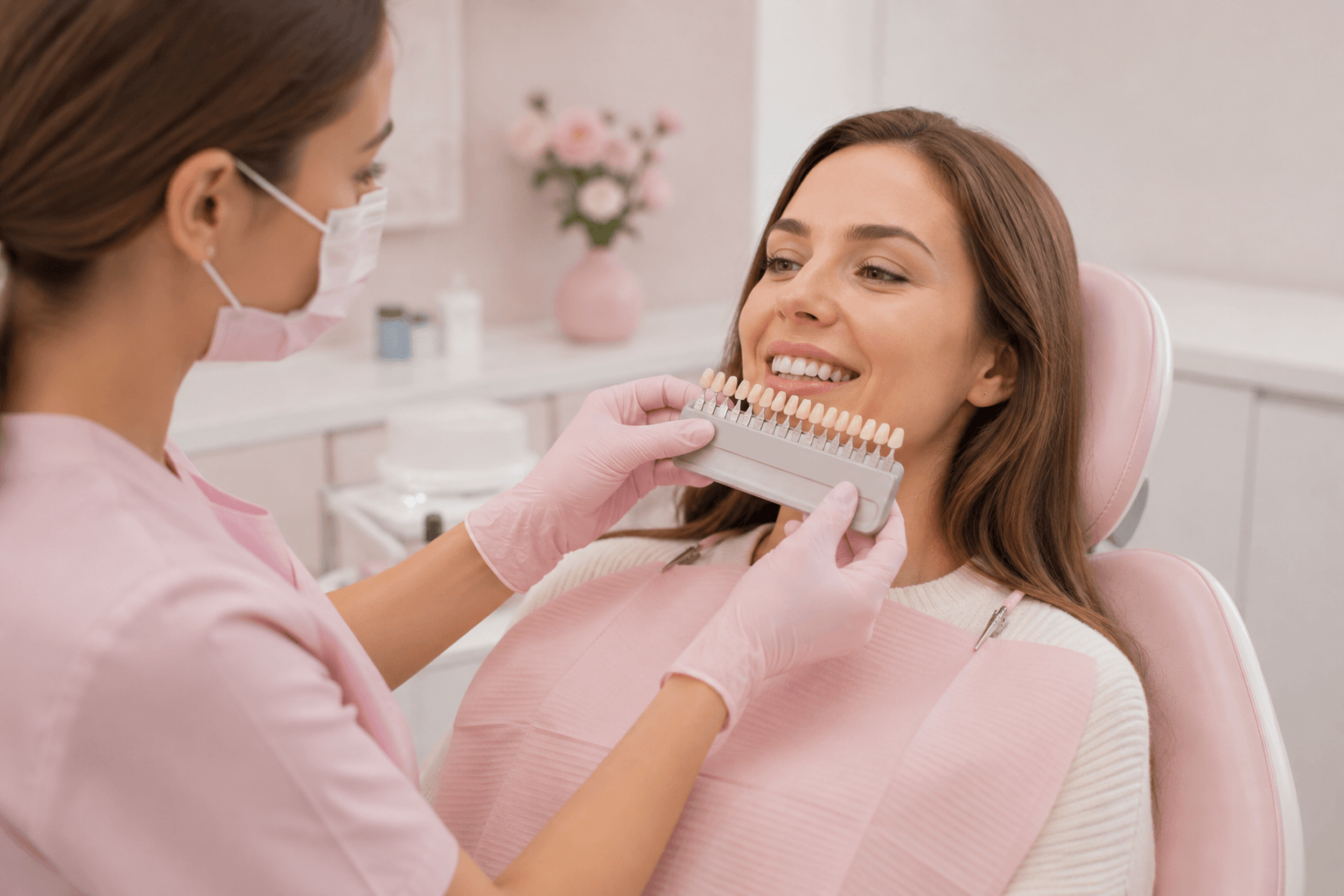
This option is for people who have been treated before and want to bring the shade back rather than start from the beginning. It is a maintenance format, and it is defined by who you are rather than by what is done: it is available to returning customers specifically.
As published, it comprises a pre-consultation in a local centre, a laser teeth whitening treatment, and aftercare. The treatment and aftercare mirror the first-time route, but the consultation does not, and that difference is the single most important thing to understand about this option.
The pre-consultation for this treatment takes place at a local centre rather than in your home. Everywhere else in the published service the assessment comes to you; here it does not. Where those local centres are, how far you might need to travel to one, and whether availability differs by area are not published. If you chose this route on the assumption that it worked like the home-visit option, the consultation stage would come as a surprise. It is worth establishing where you would actually need to go before treating this as the more convenient choice.
The format suits people whose teeth have gradually drifted back towards their original shade and who already know how they responded to treatment. That prior experience genuinely changes the conversation. You know whether you experienced sensitivity, roughly how long the effect held, and what the process felt like, which makes the assessment more informative than a first consultation on someone with no history to draw on.
Because it is a refresh rather than a first treatment, timing deserves particular thought. Whitening more frequently than your teeth actually require is not a route to a better result, and how soon a repeat is appropriate depends on how your teeth responded previously and on the current condition of your enamel and gums. That is a judgement for the specialist assessing you, not something to determine from a calendar or from how the shade looks to you in a bathroom mirror.
Anything that has changed since your last treatment should be raised. New crowns, veneers, bridges or fillings, recent dental work, a change in sensitivity, or any gum problems that have developed in the interim all affect what is advisable now. A previous treatment that went well is not a guarantee that circumstances are unchanged.
What the pre-consultation stage is for
Every published treatment includes a pre-consultation, and it is the stage most likely to be underestimated. It is not an administrative formality before the real appointment; it is where the decisions that determine your result are actually made.
The published process begins by matching the existing shade of your teeth and explaining the procedure. Recording the starting point matters because whitening is a relative change rather than an absolute destination, and without a documented baseline there is no honest way to describe afterwards what the treatment achieved. It is also the moment at which a realistic expectation gets set, which is far more useful before treatment than after it.
The assessment is also where suitability is established. The business's own screening asks about prior whitening, how heavily the teeth are stained, and whether there is any damage to the teeth, which indicates the kind of factors being weighed. Existing restorations are a particular consideration: whitening gel acts on natural enamel, and crowns, veneers, bridges and white fillings do not respond to it the same way, so a mismatch between treated natural teeth and untreated dental work is a real possibility that needs anticipating.
It is a genuine possibility that a consultation concludes treatment is not appropriate, or not appropriate yet. That is the stage doing its job. What happens in that situation is not published in detail, so if it would affect your decision it is worth asking about directly rather than assuming.
What happens during the whitening appointment itself
The treatment stage is common to each published option, and knowing its sequence makes the differences between them easier to judge. It also tends to settle the nerves of anyone who has only ever used a home kit and is unsure what a professional treatment actually involves.
Preparation comes first. A protective barrier is placed around the gums so that the soft tissue is shielded from the whitening gel before any of it is applied. This step is the main practical difference between a professional treatment and an unsupervised kit, where gel routinely ends up in contact with gum tissue simply because nothing is holding it away.
The whitening gel is then applied across the teeth being treated. A light source is used to activate it, which is what allows the gel to work on staining held within the enamel rather than sitting on the surface of it. The published treatment is described as taking around an hour, though what any individual appointment involves is something only the specialist attending can confirm for your circumstances.
During the active stage you will be sitting still with the gel and light in place, which is why the earlier point about uninterrupted time matters. It is not a procedure you can pause halfway through to answer the door or deal with something urgent, and treating it as a fixed appointment rather than a flexible one makes for a considerably smoother experience.
Some people experience temporary sensitivity during or shortly after the process. That is a recognised possibility rather than a certainty, and how it applies to you depends on your own dental history, which is precisely the sort of thing the consultation stage exists to establish beforehand. If you have a history of sensitive teeth, raise it at the assessment rather than discovering how it affects you mid-appointment.
Where aftercare fits into each treatment
Aftercare appears in every published treatment, and its importance is easy to underestimate because the treatment itself feels like the finished article. It is not. What happens in the days immediately afterwards has a genuine bearing on how the result settles and how long it holds.
The reason is straightforward. Teeth stain through ordinary contact with strongly coloured food and drink, and the period directly after whitening is when they are least equipped to resist it. Tea, coffee, red wine, dark sauces and smoking are the usual culprits in everyday staining, and moderating exposure to them in the immediate aftermath is the single most practical thing within your control.
Longer-term maintenance is less dramatic and more habitual. Consistent oral hygiene, rinsing after strongly coloured drinks, and being realistic about what daily consumption does to a shade over months will do more for the durability of a result than any single intervention. None of this stops teeth staining again eventually; it changes the rate.
What the published aftercare actually consists of is not stated. Whether it is written guidance, a follow-up conversation, a product, or a combination is not something this page can tell you, and the differing description attached to the two-person option makes the question more pointed rather than less. If aftercare is a factor in your decision, ask what it comprises before you choose between treatments rather than after.
Weighing the options against your own circumstances
Once you know which treatment format is appropriate, you can check the current LA Teeth Whitening Portsmouth Prices for Portsmouth rather than relying on figures reproduced elsewhere.
The most reliable way to choose is to work from your own situation rather than from which description sounds most appealing. A handful of questions narrow it down quickly.
Start with whether you have been treated before, because that is a genuine dividing line rather than a preference. The refresh route is defined by being for returning customers, so if this would be your first professional whitening it is not the relevant option regardless of how well it might otherwise fit.
Then consider whether anyone else is involved. If two people want treatment connected to the same occasion, arranging it together removes a coordination problem. If only you are being treated, the individual route is the straightforward answer and there is nothing to weigh.
Next, think honestly about where you can be assessed. If travelling to a local centre would be difficult, that materially affects the refresh route, whose consultation stage is the one part of the published service that does not come to you. It is worth establishing what that would mean in practice for your area before assuming convenience.
Finally, weigh what you actually want to achieve. A first treatment on noticeably stained teeth and a maintenance top-up on a shade that has drifted slightly are different jobs, and the honest answer to how much change is achievable depends on what is causing your discolouration. Surface staining from food, drink and smoking generally responds differently from deeper colour within the tooth, and nobody can tell you which you have without looking.
Whichever direction you lean, treat the consultation as the point at which the decision is confirmed rather than merely processed. It is entirely reasonable to arrive with questions, and a treatment that turns out not to suit you is better identified at that stage than committed to and regretted.
Details that are not published anywhere
A page describing treatments should be candid about where the published information runs out, because these gaps tend to be exactly the things people assume rather than check.
Nothing is published about how far in advance appointments need arranging, what notice is required to move or cancel one, or whether any charge attaches to a late change. There is no published deposit arrangement and no published refund or cancellation policy. If a consultation concludes that treatment is not appropriate for you, what happens next is not set out.
The composition of the aftercare is not described in any of the treatments, and the difference in how it is worded for the two-person option is not explained. The locations of the local centres used for refresh consultations are not published, nor is any indication of how far you might need to travel.
Nothing published defines what qualifies someone as a returning customer, whether any period of time has to have elapsed since a previous treatment, or how long the interval should be before whitening again. There is also no published complaints procedure.
None of this means the answers do not exist; it means they are not published, and this page is not going to invent them. Each is a reasonable and specific thing to ask before committing to anything.
If you need to clarify availability, treatment arrangements or any of the details that are not published on the website, you can use the Contact page to ask directly.
Questions about choosing a whitening treatment
Important information about these treatments
Everything described on this page relates to a cosmetic treatment rather than a health service, and nothing here is dental advice, a clinical assessment, or confirmation that any treatment is appropriate for you. Descriptions reflect what the business publishes about what each option includes; they are not an assessment of your teeth.
Nothing on this page should be read as a promise about results, comfort, duration or suitability. Whitening outcomes vary between individuals, whitening is not appropriate for everyone, and no description on a website can determine which applies to you. Where this page states that something is not published, that reflects what could be verified at the time of writing rather than a claim about what may exist elsewhere or change in future.
If you have any concern about your oral health, existing dental work, or whether whitening is advisable in your circumstances, speak to a qualified dental professional before proceeding.